H. Holck
Oceanic pH has been dropping in recent years as a result of increased atmospheric CO2 concentrations.* But what are the implications for ocean acidification on ocean life? The Great Barrier Reef has been in the news lately because it is dying. Coral death has resulted from increased bleaching—a process wherein coral release their vital algae. Without algae, coral die. A recent study published in the Proceedings of the National Academy of Sciences concluded that a lower pH causes coral bleaching.
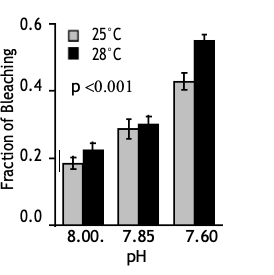
Researchers followed coral at different pH and temperatures for a period of 8 weeks. Their results quantify the amount of bleaching compared to control coral which kept at the same two temperatures but the current ocean pH 8.16. For both temperatures, coral bleaching increases as a result of ocean acidification (lower pH). The more acidic ocean water gets, the more bleaching occurs in coral. A pH of 7.6, lower than the control by 0.56, resulted in a 50% bleaching. While some might argue that the results are not significant and that bleaching doesn’t truly increase as a result of acidification, the p-value disproves this objection. A p-value of less than 0.001 means that the increased bleaching is significant because there is less than 0.1% chance that the results are purely random.
*From Anthony
Coral bleaching significantly increases as a result of ocean acidification from elevated CO2 concentrations in the air. If the ocean continues to decrease in pH, as it has over the past 100 years, coral will continue to die. Coral play an integral role within the ocean’s ecosystem by providing homes to millions of juvenile fish. Without reefs, juvenile fish would no longer have a protected home to grow and thus would struggle to survive into adulthood. People living in developing countries in East Asia depend on fish as a majority of their diet and primary source of protein.** They would suffer from malnutrition if there was a decline in the sea fish population. Because so many humans rely on fish to maintain their health, we need to ensure that our ocean is protected. Raising awareness about the negative effects of ocean acidification could lead to conservation efforts that protect coral and fish populations.
*Anthony, K.R.N, et. al, “Ocean Acidification.” Proceedings of the National Academy of Sciences vol. 105 (2008).
**The State of World Fisheries and Aquaculture, 2008.
