H. Holck
Each year we release millions of metric tons of CO2 into the atmosphere via fossil fuel combustion. Once in the atmosphere, CO2 remains there for years. How can we be certain that our CO2 emissions truly have any climate altering effects? In recent years, scientists have become concerned about the diminishing population of coral reefs as a result of ocean acidification. A study published in the peer reviewed science journal Oceanography linked atmospheric concentrations of CO2 with ocean acidification. Researchers found that our increased CO2 emissions have caused ocean acidification, disrupting ecosystems and causing coral reefs to decrease in abundance.
An increase in atmospheric CO2 concentrations causes an increase in oceanic CO2. Their slopes indicate that oceanic CO2 is dependent on atmospheric concentrations because its slope of 1.81 rises slightly behind atmospheric CO2’s slope of 1.9. The graph further highlights that the pH is decreasing as a result of increased CO2 emissions and oceanic concentrations—a process which occurs when water absorbs and reacts with CO2, producing a weak acid. Although the pH decreases by only 0.06, pH is measured on a logarithmic scale meaning that it really changed by 14% since 1988. This decrease can be considered significant because for the past 300 million years pH levels have hovered at 8.16.** Therefore today’s decrease significantly deviates from historical oceanic trends. These changes, seemingly small, have a significant impact on the oceanic environment because coral are particularly vulnerable to more acidic conditions.
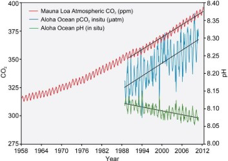
Researchers showed that human CO2 emissions have caused an increase in oceanic CO2 levels, ultimately causing a decrease in pH levels. pH levels have already dropped enough to alter oceanic environments, harming existing oceanic coral. Should the downward trend continue at the current rate, the pH would decrease by 100% in 100 years. Since today’s acidification has already disrupted the ocean’s ecosystem, scientists are concerned about what could happen in the future if we continue having high CO2 emissions levels. Lowering our emissions with a greater reliance on non-CO2 producing energy sources could be the key to stabilizing oceanic pH and preventing further ecosystem disruptions.
*Feely et. al. Oceanography Vol. 22, No. 4. (2009).
**P. D. Thanker, Environmental Science Technology. 2005, 39, 10A.
