H. Holck
Contrary to popular opinion, Earth is not just going through another natural atmospheric ‘phase.’ The increase in atmospheric CO2 is not another fluctuation of natural trends. In 2016, the U.S. released over 6,511 million metric tons of CO2 into the atmosphere, thereby contributing to the increase in atmospheric CO2.* A study published by the National Oceanic and Atmospheric Administration (NOAA) shows that today’s CO2 levels drastically exceed historical levels.
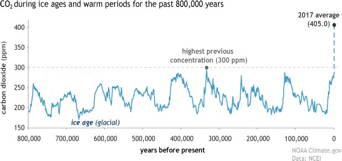
NOAA used sensitive methods to measure atmospheric CO2 concentration over the past 800,000 years. In the past century, atmospheric CO2 has increased rapidly unlike past trends when CO2 concentration rose and fell but never exceeded 300 ppm. Although some might argue that today’s highs are just typical fluctuations of the graph, 2017’s atmospheric concentration is 30% higher than it has been for the last 800,000 years. Recent atmospheric CO2 significantly rose from natural variation where CO2 oscillated between 180 and 300 ppm.
NOAA discovered a significant increase in atmospheric CO2 concentration, above the historical high of 300 ppm, to a new record high of 405 ppm in 2017. Because current levels deviate so significantly from historical levels, today’s CO2 concentration cannot be characterized as just another natural atmospheric ‘phase.’ Raising awareness about high atmospheric CO2 concentration might lead to more activism to bring CO2 below 300 ppm. Since fossil fuel consumption produces 93% of CO2 emissions, alternative energy sources could help reduce atmospheric CO2.*** Bringing down CO2 concentration to historical levels could restore the Earth’s atmosphere, paving the way for a brighter, greener future.*
* https://www.epa.gov/ghgemissions/overview-greenhouse-gases#carbon-dioxide
**NOAA. Climate Change: Atmospheric Carbon Dioxide. 2018.
*** Draft Inventory of U.S. Greenhouse Gas Emissions and Sinks. 2019.
