H. Holck
Today, some remain unconvinced that humans are directly contributing to climate change. New studies conducted by the U.S. Environmental Protection Agency (EPA), however, show otherwise. In my previous post, we examined how humans are causing a steep, unnatural rise in CO2 emissions that would not have occurred otherwise. But how are we causing the rise? Which fossil fuel-consuming activities contribute to our emission of CO2? In their 2016 report on greenhouse gas emissions, the EPA quantified the amount of CO2 emissions per largescale economic sector in the U.S. The EPA reported that transportation and industry sectors, which are the direct results of human actions, were the two largest contributors to CO2 emissions.
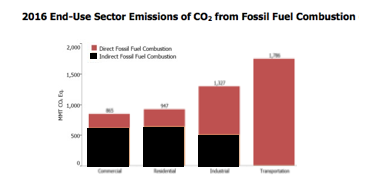
The amount of direct and indirect CO2 emissions in millions of metric tons (MMT) from fossil fuel combustion per sector in 2016. *From EPA
The EPA differentiated between energy obtained directly from combustion (red) and energy purchased indirectly through a third party which burned fossil fuels themselves (black). The two largest sources of CO2 emissions are transportation, which includes vehicular combustion, and industry, which includes manufacturing, agriculture, and mining. The study further reveals that indirect emissions, generated by energy companies, contribute 1809.3 million metric tons (MMT), a total roughly equal to transportation’s 1,786 MMT. As the largest source of direct emissions, transportation, indicates human contribution to CO2 emissions, since vehicles directly release the gas during daily commutes. It could be argued that the results lack significance because the data fail to include non-human sources of CO2 emissions, which also contribute to global emission levels. However, a recent study showed humans “produce more than 80%” of CO2 emissions.** Together with the data from the EPA, it can be concluded that humans are responsible for the majority of global CO2 emissions.
Humans directly produce CO2 emissions daily via transportation, residential, industrial, and commercial energy use. While revealing the ways humans contribute to emissions, the graph also highlights possible avenues for solutions. With transportation releasing over 1,700 MMT of CO2 annually, switching to electric cars could significantly lower its direct CO2 emissions. Moreover, as indirect fuel combustion collectively constitutes 37% of human emissions, investments in non-CO2 producing energy like solar could further lower emissions. Together these efforts could decrease emissions by 73%.
*EPA, Draft Inventory of U.S. Greenhouse Gas Emissions and Sinks: 1990-2017, chapter 2.
** Koerner and Klopatek, Journal of Environmental Pollution Vol 116. (2002). pg. S45-S51.
