J. George
A common problem found in institutions of higher education is sleep deprivation. Despite the recommended 8 hours of sleep each night, many students decide to pull “all-nighters” believing the extra studying is more beneficial than a good night’s sleep. The problem with all-nighters is sleep deprivation, which is corelated with a weaker short-term memory. One of the earliest studies on sleep deprivation was conducted by Williams et al in 1966 to determine its effects on short term memory. In the study, 22 US soldiers between the ages of 19 and 44 were given a unique list of 25 one-syllable words to memorize. Each word was spelled from a recording and then written by the soldier. Each soldier took a baseline test to show how time alone affected memorization without sleep deprivation. They were then given a new list and were tested again after 31 and 55 hours of wakefulness. Comparing the performance clearly showed that sleep deprivation decreased their scores.
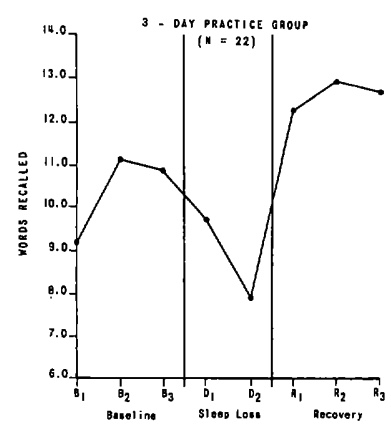
memory with and without
sleep deprivation. *Williams
et al
Figure A compares the soldiers’ performance with 7.5 hours of sleep each night with their performance with no sleep. The data show that while time itself did not decrease performance of word memorization, sleep deprivation did. Furthermore, the amount of sleep deprivation impacted the degree to which immediate recall was decreased. The graph shows how 31 hours of wakefulness decreased performance by approximately 9% and 55 hours of wakefulness decreased performance by almost 30% as compared to 55 hours with sleep. This supports the claim that sleep deprivation does, in fact, decrease one’s ability to recall information. While some may argue that the soldier’s differences in intelligence or ability to memorize information render the data insignificant, this argument is refuted by the fact that the same soldiers were tested both with and without sleep, therefore the difference in performance is solely due to the amount of sleep.
The data support the idea that sleep deprivation has a negative effect on memory performance. They also convey that memory becomes increasingly worse with higher sleep deprivation, and therefore the amount of sleep one receives is also an important aspect of how well one can recall information. While students may be tempted to stay awake all night to study, the results show that sleep deprivation has adverse effects on their performance. While the study only observed memory of simple words, it is likely that recalling complex information, like the simple words, would be a much more difficult task with sleep deprivation.
Williams et al, Some Effects of Sleep Loss on Memory, 1966
