E. Johnson
In the early 21st century, it was hypothesized that the MMR vaccine caused the formation of a “new variant of autism” which leads to developmental regression. Developmental regression is the “deterioration … of development or loss of skills” in children. Since there are numerous anti- vaccine parents, this association only fuels the misconception that the MMR vaccine leads to autism in children. After monitoring autistic children’s developmental progress for 20 years, scientists kept track of the percent of children with regression. The MMR vaccine was introduced in 1988, yet the regression frequencies remained stable. The evidence does not support a link between the MMR vaccine and regression in autism.
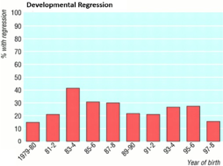
Since 1988 when the MMR vaccine was first used, rates of children with regression has not increased. Percentages of regression in the first year of the study are like that of the last year of the study. Over the past two decades, percentages have fluctuated slightly, but remained below 30% in time point but one. Some may point out that about 40% of autistic children born from 1983 to 1984 experienced developmental regression which they use as evidence of a link between MMR vaccines and autism. While 40% is high, the MMR vaccine was not administered until 4 years later, so another factor must have caused that temporary increase in regression. Since MMR’s first use, regression has remained consistent with pre-MMR levels.
By providing evidence against the existence of a new variant of autism, the misconception that vaccines lead to autism will weaken. Because developmental regression levels remained stable over the years of the study, the data do not support the link between the MMR vaccine and regression within autism. Anti-vaccine parents will persist, and fewer children will be vaccinated, because of a misconception that vaccines cause autism. As fewer children have been vaccinated, more outbreaks of diseases like measles have occurred when in previous years these diseases were thought to be extinct.
