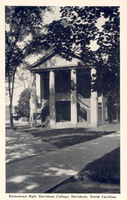
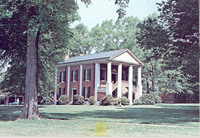
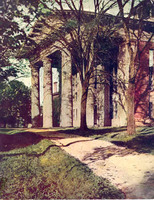
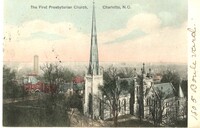
Built in 1849 and dedicated in November 1849. Restored in
1956. Placed on National Historic Register in 1972. Named Charlotte
Mecklenburg Historic Site in 1976.
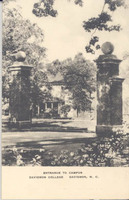
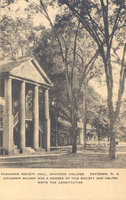
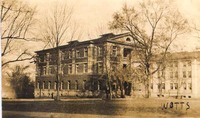
Post cards printed in September, 1946, with historical data supplied by Dr. Chalmers G. Davidson. From photographs belonging to the Public Relations Department, most taken several years earlier. Examples of cards printed in 1946 for sale at the college pharmacy (better known at "Hugo's") in Davidson.
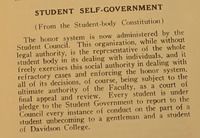
The first formal student organizations on Davidson’s campus were the Philanthropic and Eumenean Literary Societies founded within months of the college’s opening. Along with providing students opportunities to debeate and practice public speaking, the literary societies helped organize events around commencements and supported the first student publications. As the 19th century turned into the 20th, students began to organize additional clubs and societies around shared interests and desires for more social activities. With the increasing number of student groups came an interest and need to provide coordination and in some cases regulations for them.
The first Greek letter society in the United States was founded in 1776 at the University of William and Mary. Called Phi Beta Kappa, the secret organization was created with the purpose of fostering brotherhood among its members (Student Involvement). This fraternity, as with most original fraternities, focused on studying the classics, and created opportunities for its members to discuss topics such as philosophy, Greek literature, and history. By 1893, Phil Beta Kappa chapters were shifting from literary and social activities to celebrating academic achievements and thereby establishing a new tradition of honorary societies and fraternities.
At Davidson College during the 1960’s, there was growing concern that social life was at the mercy of the fraternities. Independents (non-fraternity members) did have teams participating in inter-fraternity sports, but remained socially separate from fraternities (Three). In response to this, Davidson encouraged students to found various organizations to diversify social opportunities on campus. Among these were clubs and service fraternities such as Lingle Manor and Alpha Phi Omega. The integration of women as students and degree candidates in 1972 further challenged the men at Davidson to integrate their female peers into social life on campus. This brought on the establishment of co-ed eating houses, which would set a precedent for the strong presence of eating houses on Patterson Court in later years.
In the 1970s, a more liberal student body began to emerge out of the New Left movement, noticeable in the growing anti-Vietnam War sentiments that larger and larger groups of students began to embrace (Blodgett 199). Students, facilitated by public interest groups, which worked from a more non-partisan angle, began to speak out more frequently on environmental and consumer-based issues. At the turn of the 21st century, liberal student activism had become an even larger part of life on campus. With the rising conflict in the Middle East, students and faculty began to speak out against the war in Iraq. This belief was afforded by groups like Just Peace, providing a safe space for peaceful discussion. Although Davidson has not been a historically activist campus, it has been involved in political movements and has been a part of nationally evolving social trends.
At Davidson, the onus of organizing and contributing to community service is, for the most part, on the students. As a result, it is not surprising that over the years there have been a number of successful student-lead groups on campus that have created opportunities for participation in and have spread the awareness of service and civic engagement.
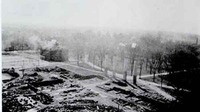
A stunning, indeed staggering blow squarely in the face was received by the College in the burning on the morning of November 28th of Chambers building.
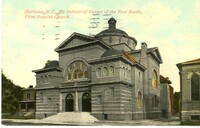
Charlotte, N. C. The Industrial Centre of the New South, First Baptist Church [printed on front].
Postcard sent to Miss Cornelia Shaw in Davidson, June 6, 1911, from Eugene Alexander (Class of 1912). Cornelia Shaw was Davidson College's first full-time librarian (she also served as the college's registrar).
Text of postcard: "Mother seems better at times but is so weak all the times Does not take any nourishment at all. This warm + dry weather is very much against her. Everything is almost burned up here on farm. I have had little chance to farm any yet. Hope you have rested from [. . .]. Eugene A."
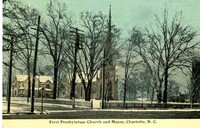
Postcard sent to Cornelia Shaw, Davidson College's first full-time librarian (she also served as the college's registrar), from Joseph Treloar Wearn (Class of 1913). Shaw authored the first history of the college ("Davidson College", Fleming H. Revell Press, 1923).
Text of the postcard:
"Things are almost as quick in Charlotte as in Davidson. [But] am having a good time any way. Haven’t forgotten the 35¢ I owe the library, al. though I did forget it when I left. Pleasant summer to you. Treloar Wearn."
1805 Boulevard [handwritten on front] No. 2892 [printed on back].
The postcard is addressed to Mrs. Stirewalt in Davidson, September 16, 1908. Mrs. Stirewalt is Sarah Ann Hampton Stirewalt, whose daughter Sallie Paisley ran a boarding house in Davidson and whose son Bynum Stirewalt graduated from Davidson College in 1884.
Text of the postcard: "Dear Mrs. Stirewalt how are you I hope you are well and doing fine. I miss you for I [. . . ] like you to go to see in Charlotte. Come down and I'll go to see you."