In the second page of his letter, Pinckney Brown Chamber '40 describes an incident in which Davidson students faced disciplinary action for dining with "Lemley's Negroes".
Eleven black men in formal dress pose in front of the wall of a building. Depicts "Tom", "Joe", "Otho", "Lewis", "Alex", "Aaron", "Jack", "Jim", "Holtzclaw", "Syd", and "Rich".
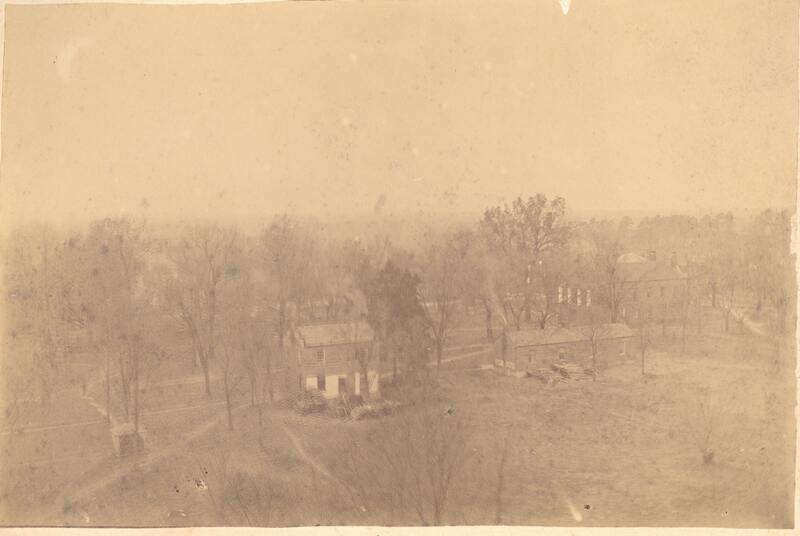
An aerial picture of Davidson College taken facing the direction of North Main Street. Depicts the old latticed well, a two story brick faculty house, Elm Row, and the Old Chapel.
Part of Davidson's original campus, dedicated in 1836 and built in 1837. Used for religious services conducted by both the college and the town until the town received their own building in the 1880s. Converted into Shearer Hall in 1901.
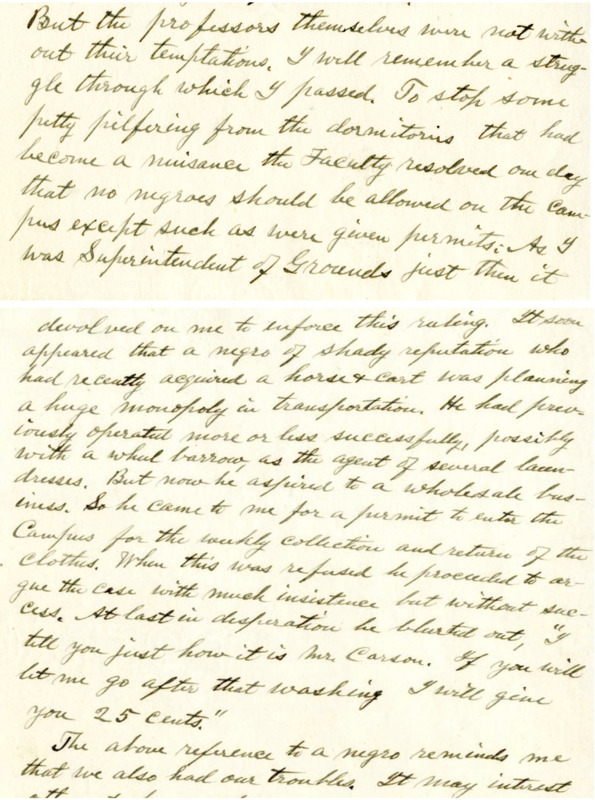
In this letter, William Waller Carson, Professor of Mathematics at Davidson College from 1877 to 1883 and Superintendent of the Grounds, writes about rejecting a permit submitted by a local Black man to transport laundry to the student dorms.
Included in the history of the sciences at Davidson College is the founding of the North Carolina Medical College. Incorporated in 1893, the North Carolina Medical College was the first chartered medical college in North Carolina and had its roots in Davidson’s pre-medical program. The “president” of the college was Dr. John Peter Munroe, a Davidson College physician and professor. In 1896, Dr. Munroe bought a lot from Davidson College and built on it a three-story brick building for his college.
Oak and Elm rows were two of the original eight buildings erected on the Davidson College campus. The building of the campus began in 1836 with only 250,000 bricks and in 1837 the first students became the inhabitants of the rows.
First constructed as a store in 1848. Purchased in 1855 by
Hanson Pinkney Helper and remodeled into a thirteen-room hotel. Purchased around 1901 by the Sloan family and operated as a boarding house and weekend rooming house for visiting college girls. Purchased by the college in 1946. Used in the 1950s and 1960s as a Teen Canteen. Renovated in 1971. Designated as a Charlotte Mecklenburg Historic Site in 1977.